
Best Joker Tattoo Designs 2026: Realistic Portraits, Dark Art & Comic Book Ideas

Updated: May 15
What makes a good Joker tattoo?
A good Joker tattoo combines technical portraiture skill with understanding of the character's psychological depth. Best designs capture specific interpretations (Heath Ledger, Joaquin Phoenix, classic comic book versions) rather than generic clown imagery. Success depends on artist experience with realistic portraiture or stylized illustration, strategic placement on low-movement areas (back, thigh, chest), and understanding that Joker tattoos carry psychological meaning—chaos, unpredictability, duality of good/evil. Cost: $300-$2,500+ depending on size and detail; healing: 3-4 weeks.
TABLE OF CONTENTS
What Does a Joker Tattoo Actually Mean? (Beyond Pop Culture)
The Joker vs Harley Quinn Tattoo: Different Symbolism, Different Impact
Joker Smile, Joker Face, Full Portrait: Which Design Works Best
Placement Strategy: Where Your Joker Tattoo Either Succeeds or Fails
The Psychology of Chaos: Why Joker Tattoos Demand Specific Artists
Real Cost Breakdown: Why Good Joker Tattoos Cost What They Do
Finding the Artist Who Understands the Character (Not Just the Image)
Why Most Joker Tattoos Look Cheap (The Brutal Truth)


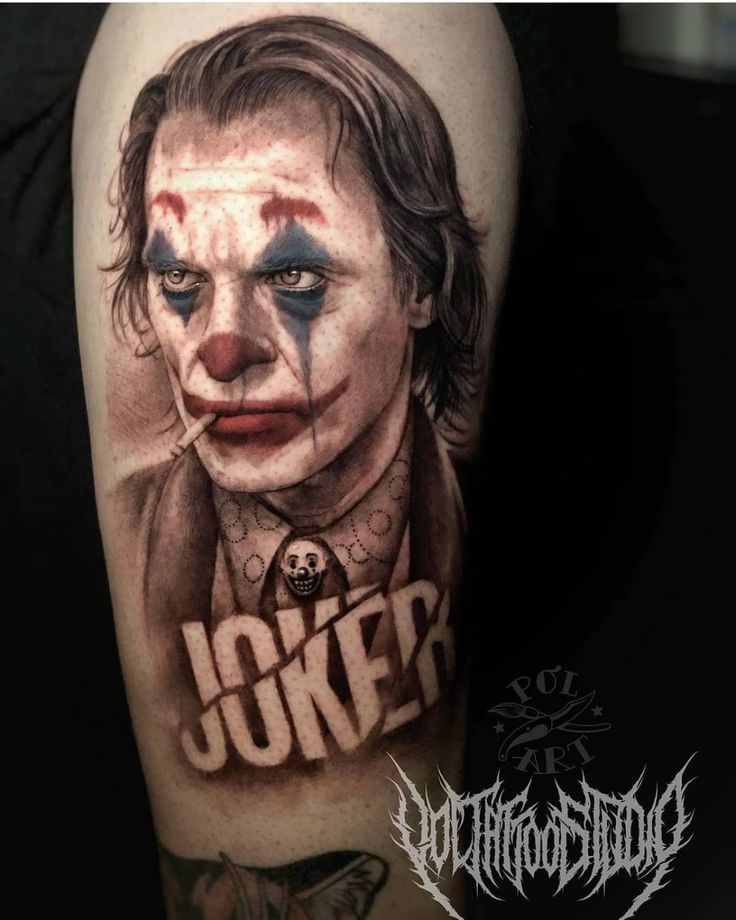
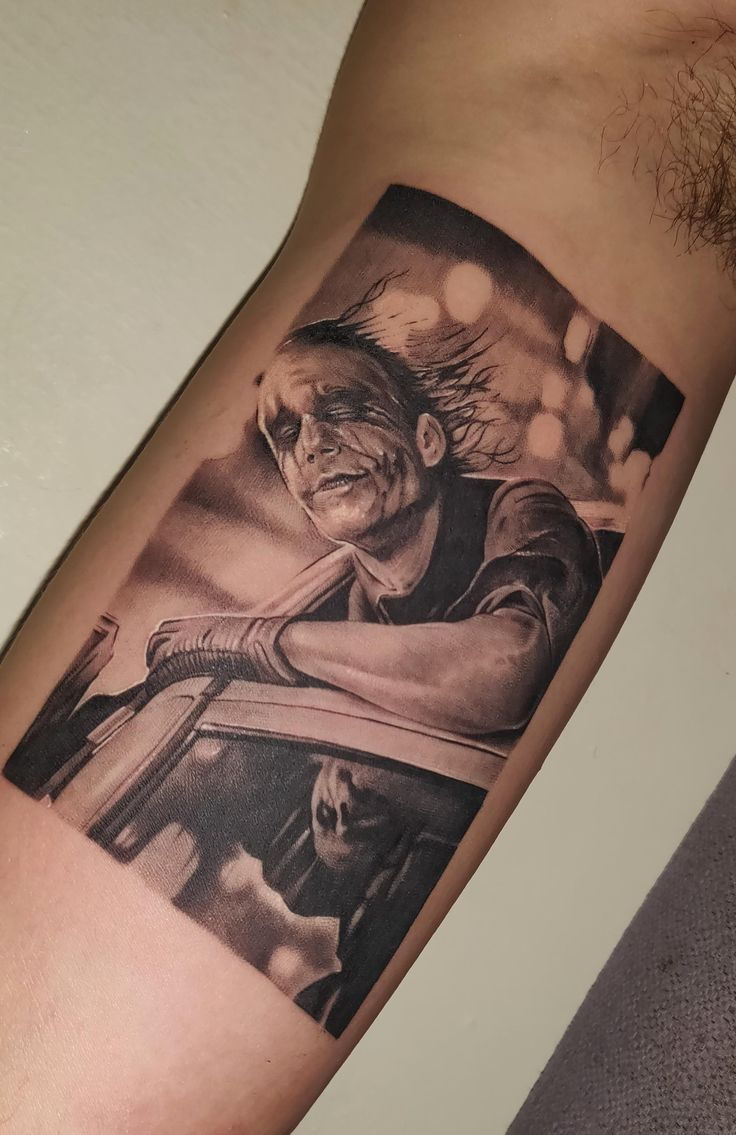


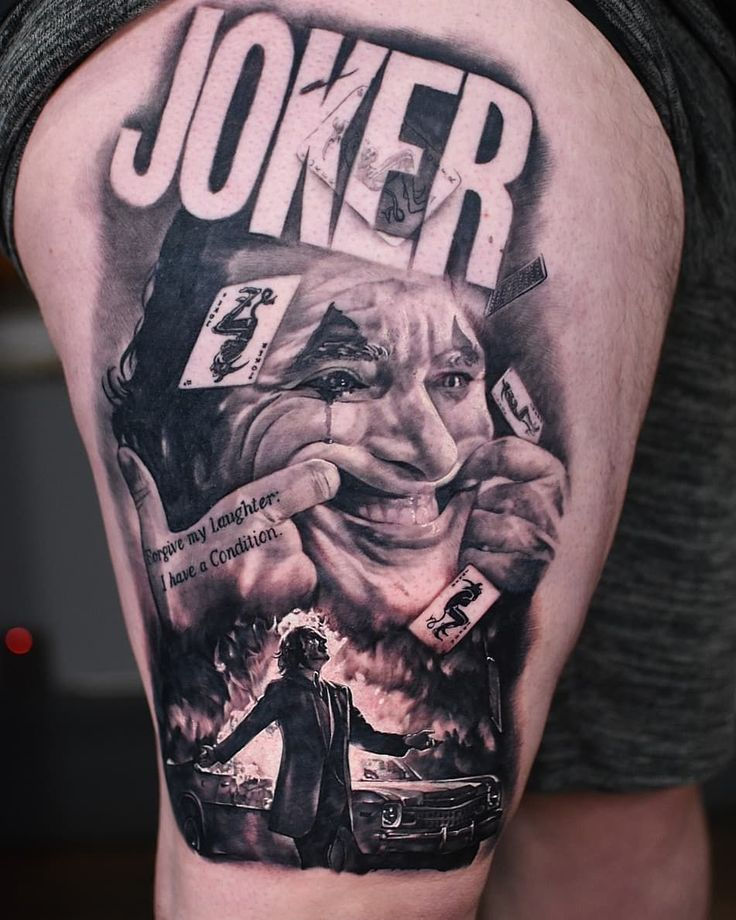

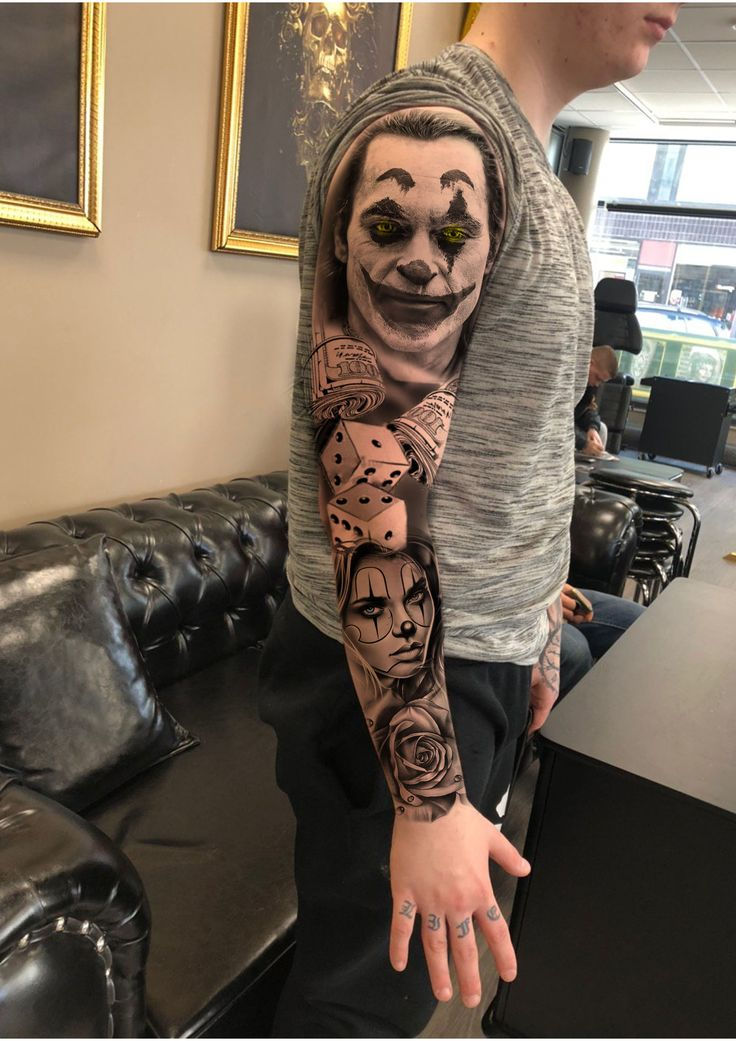


Here's something nobody wants to admit: most Joker tattoos are terrible.
Not because people don't care. Not because artists aren't skilled. But because people treat Joker tattoos like they're just cartoon characters rather than psychological statements. They get whatever artist has an opening. They don't think about how the design will age. They book based on price, not expertise.
A bad Joker tattoo looks like a smiling clown with heavy makeup. It's generic. It could be any jester, any circus performer. By year three, the fine detail around the eyes blurs. The makeup details become muddy. The expression that made it interesting flattens into something unrecognizable.
A good Joker tattoo is entirely different. It captures something psychological. It's not just a face—it's an expression of something darker. The eyes convey menace or madness or introspection. The composition suggests context and meaning. The execution is precise enough that five years later, it still commands attention.
The difference comes down to artist selection and design philosophy. Are you getting a Joker tattoo because you like the character? Or are you getting a portrait that happens to depict a specific interpretation of the Joker?
That distinction determines whether your tattoo is forgettable or iconic.
What Does a Joker Tattoo Actually Mean? (Beyond Pop Culture)

When you get a Joker tattoo, you're not just referencing a fictional character. You're making a statement about how you see the world.
Historically, the Joker has represented chaos, unpredictability, and the rejection of societal rules. In Batman lore, the Joker is the ultimate agent of chaos—someone who operates outside normal morality, who challenges every assumption, who finds humor in darkness. Getting a Joker tattoo can mean you identify with those themes on some level.
But Joker tattoos carry deeper psychological meaning too. Research on tattoo psychology suggests that people drawn to Joker imagery often relate to themes of abandonment, lost love, or the duality between their external presentation and internal reality. The Joker's smile—painted on, forced—contrasts with the darkness underneath. People who get Joker tattoos often report that this duality resonates with them.
The specific version matters enormously. A classic comic book Joker suggests appreciation for traditional storytelling and aesthetics. A Heath Ledger-inspired Joker (dirty, chaotic, genuinely disturbing) suggests attraction to rawness and psychological complexity. A Joaquin Phoenix Joker (vulnerable, damaged, tragic) suggests empathy for broken people. A Jared Leto version (which most people regret) suggests... poor decision-making.
Understanding what your chosen Joker represents matters because it affects the design. You're not just getting a face. You're capturing a psychological statement that will be on your body for life.
The Best Joker Tattoo Designs That Age Well

Good Joker tattoos share consistent characteristics: they work as portraiture, they capture specific interpretation, and they age beautifully rather than fade into irrelevance.
Realistic portrait work represents the gold standard. When done by an artist experienced in realistic portraiture, a Joker portrait can be genuinely striking. The technical challenge of capturing facial likeness, expression, and psychological depth on skin is enormous, but the payoff is a piece that commands attention for decades. A well-executed Heath Ledger portrait becomes more iconic over time as the film recedes into the past.
The challenge with realistic Joker portraits is that they demand the artist understand portraiture deeply. Any weakness in proportion, shading, or eye detail becomes immediately obvious in a face. A mediocre realistic Joker portrait is worse than a well-executed stylized one because it's trying to be realistic and failing.
Black and grey realism dominates the Joker tattoo world because it solves technical challenges beautifully. Black ink doesn't fade like colors. The makeup details that define the Joker's appearance—shadow under eyes, asymmetrical designs, painted-on expression—work perfectly in black and grey. You're not relying on color vibrancy. You're building everything through shading.
Stylized/Neo-Traditional designs work well for Joker work because they embrace the theatrical nature of the character. Instead of trying to capture photorealism, these designs lean into exaggeration, expression, and psychological impact. A Joker done in stylized style with heavy lines and bold composition can be more effective than a realistic version that misses emotional depth.
Minimalist designs can work if executed with purpose. A simple Joker smile line, the iconic "HaHaHa" text with specific styling, or just the essential elements of the character can be powerful if they're designed thoughtfully. The danger is that minimalist work looks worse as it ages—fine lines blur more than bold ones.
Playing card integration appears in many good Joker designs. A joker card can be combined with portraiture, adding context and meaning. The playing card itself—especially if designed with specific symbols or modifications—creates a complete composition rather than just a character floating in space.
See More: ⤵
Nipple Tattoos: A Comprehensive Guide to Areola Reconstruction and Decorative Designs
Hip Tattoos: The Ultimate Guide to Choosing and Caring for Your Sexy Hip Ink
Divergent Tattoos: A Comprehensive Guide to Choosing, Placing, and Caring for Your Ink
Forearm Tattoos for Women: Styles, Inspiration, and Considerations
Sleeve Tattoos for Men: The Ultimate Guide to Designing and Rocking Your Ink
Best Friend Tattoos: Celebrating the Unbreakable Bond of Friendship
Wave Tattoo: Unleashing the Power and Beauty of the Ocean on Your Skin
Wrist Tattoos: Meaningful Designs and Ideas for Your Next Ink
Heath Ledger vs Joaquin Phoenix vs Comic Book Joker

The specific Joker you choose to tattoo completely changes the design, the meaning, and how well it ages.
Heath Ledger's Joker from The Dark Knight represents chaos incarnate. Dirty, damaged, genuinely disturbing. The makeup is asymmetrical, the expression is menacing, the entire presentation suggests danger. A Heath Ledger Joker tattoo says something about appreciating psychological darkness and raw complexity.
Tattoo-wise, Heath Ledger's version works beautifully in realistic black and grey. The makeup details, the scarred mouth, the intense eyes—all of it translates well to ink. The challenge is that realistic portraiture of this character demands serious artist skill. The expressions that make Heath's Joker compelling need to be captured precisely.
A well-executed Heath Ledger Joker portrait ages beautifully because the character itself has become iconic. Even if the actor's face fades slightly, the design maintains power because Heath's Joker is instantly recognizable.
Joaquin Phoenix's Joker from Joker (2019) is entirely different. This Joker is vulnerable, damaged, almost sympathetic. The psychology is inward-focused. The design is more stylized than realistic—exaggerated features, intentional artificiality.
A Joaquin Phoenix Joker tattoo suggests empathy for broken people, understanding of mental health struggles, and attraction to tragic characters. The design works well in stylized or neo-traditional approaches rather than strict realism because the theatrical nature is part of the character.
This version is risky for tattoos because it depends heavily on specific details—the exact expression, the makeup design—to work. If those details aren't captured precisely, the piece loses power.
Classic Comic Book Joker (varied versions across decades) represents the original conceptualization. A jester-like figure, theatrical, exaggerated, almost clownish. This version works perfectly in stylized tattoo styles.
The advantage of comic book versions is that they're less tied to specific actor interpretations. Your Joker doesn't need to look like anyone famous—it just needs to feel authentic to the character. This gives artists more freedom and makes the design less vulnerable to aging as different movie versions come and go.
The Joker vs Harley Quinn Tattoo: Different Symbolism, Different Impact

Many people get Joker and Harley Quinn tattoos together, but they carry completely different meanings.
A Joker tattoo, as mentioned, represents chaos, unpredictability, and psychological darkness. It's solitary—the Joker is fundamentally alone in his philosophy.
A Harley Quinn tattoo represents something different: devotion, obsession, the vulnerability of loving someone dangerous. Harley is defined by her relationship to the Joker. She's not chaos herself—she's someone drawn into chaos by another person.
Getting both together suggests a narrative: the relationship between chaos and obsession, between the agent of disorder and the person who follows them. Some couples get matching Joker-Harley tattoos, which is either romantic or concerning depending on perspective.
The design implications are significant. A Joker tattoo stands alone. A Joker-Harley combination needs compositional cohesion. They need to relate to each other visually while still maintaining distinct identities.
If you're considering a Joker tattoo, think carefully about whether you want it solitary or as part of a pair. That affects artist selection, design approach, and long-term meaning.
See More: ⤵️
DRAGONHAWK VS SOLONG VS INKIN: BEST BEGINNER TATTOO MACHINE KITS 2026 (TESTED & COMPARED)
Best Tattoo Balm 2026: Hustle Butter vs Aquaphor vs Mad Rabbit [Aftercare]
Tattoo Infection Signs: Is It Healing or Infected? (2026 Guide)
Tattoo Prices Explained: The True Cost of Ink in 2026 (Rates, Size & Hidden Fees)
Tattoo Healing: Timeline, Aftercare Essentials & Expert Tips
How Long Does a Tattoo Take to Heal? Complete Timeline and Stages
Joker Smile, Joker Face, Full Portrait: Which Design Works Best

Joker tattoo designs exist on a spectrum from minimal to elaborate. The right choice depends on what you're actually trying to communicate.
Joker smile only (the iconic grin, sometimes with "HaHaHa" text) is minimal and striking. A well-designed smile can be powerful—it suggests menace or madness without needing a full face. The advantage is that this design works at smaller scales and ages relatively well because it's not detailed enough to blur significantly.
The risk is that a simple smile can look cheap or juvenile without careful execution. It needs sophisticated design—proper proportion, meaningful detail—to avoid looking like a cartoon.
Joker face/head (full facial design, usually from neck up) represents the sweet spot for Joker tattoos. You get enough canvas to capture expression and psychology without committing to a massive piece. A face-sized Joker on your chest or thigh works well.
This scale demands artist skill. A face that's too small loses detail. A face that's too large becomes unwieldy. Getting the proportions right—positioning the eyes at the correct distance, capturing expression—is the technical challenge that separates good artists from mediocre ones.
Full portrait (head to chest or larger) allows for maximum detail and context. You can include hands, clothing, environment, playing cards—everything that creates a complete composition. Full portraits create impact and allow for storytelling.
The challenge is placement. A full portrait needs substantial canvas—back piece, full chest, or large thigh work. Not everyone wants something that visible or that large.
Integration with other elements (Joker face surrounded by cards, flowers with dark thorns, Joker integrated into larger scene) creates more sophisticated designs. Instead of just a face, you're creating a composition. This approach works beautifully for artists skilled in narrative design.
See More: ⤵
Playing Cards, Chaos Symbols & Why Context Matters
A standalone Joker face is powerful. A Joker integrated into a larger symbolic composition is genius.
Playing cards carry meaning: randomness, chance, risk, games. A joker card—the wild card—represents unpredictability. Integrating a joker card with the Joker character creates visual and symbolic cohesion. The design itself communicates the meaning.
Other chaos symbols work too: skulls (mortality and darkness), spiders (danger and intricate webs), thorns (beauty twisted into pain), dice (chance and risk), dice combined with cards (the gamble of chaos). When integrated thoughtfully, these elements transform a simple character portrait into a statement about chaos philosophy.
The best Joker designs aren't just faces. They're compositions that tell a story. Your artist should think beyond portraiture into narrative design.
Placement Strategy: Where Your Joker Tattoo Either Succeeds or Fails

Joker tattoos demand placement that allows proper detail and limits movement.
Ideal placements:
The back offers enormous canvas and minimal movement. A full portrait or complex composition works beautifully on back pieces. The back heals consistently well and allows detail to remain sharp for decades.
The chest provides good visibility and adequate space for face-sized designs. Shoulder movement affects healing slightly, but a Joker portrait on the chest heals well and maintains detail.
The outer thigh offers excellent canvas with minimal daily movement. Thigh placement heals beautifully for detailed work and is easily hidden or displayed as needed.
Full sleeves allow multiple elements integrated into cohesive design. A Joker portrait can be the centerpiece with supporting elements surrounding it.
Placements to avoid:
Hands experience constant friction and sun exposure. Detail blurs quickly. Any fine portraiture work on hands is risky.
The inner wrist bends constantly, disrupting healing. Finger placements offer too little canvas for meaningful detail.
Feet experience friction from shoes. The healing timeline is slower due to lower blood circulation.
Ribs cause maximum pain and heal slowly. Not ideal for detailed work.
A Joker portrait that's face-sized or larger needs to live on your back, chest, or thigh. Anywhere else, the design suffers.
The Psychology of Chaos: Why Joker Tattoos Demand Specific Artists

Not all talented artists excel at Joker work. Some specialize in traditional or geometric designs. Some in animals. Some in portraiture. You need an artist who understands psychological portraiture and can capture menace, madness, or complexity.
An artist good at traditional tattoos might not understand how to make a Joker expression genuinely unsettling. An artist good at animals might struggle with facial proportions and psychological depth. An artist skilled at portraiture might miss the theatrical exaggeration that makes a Joker special.
The best Joker artists understand:
How to capture facial likeness and expression
How to convey psychology through technique
How different Joker versions (Ledger, Phoenix, comic) require different approaches
How to use blackwork or shading to create menace
How to age designs so they maintain impact over decades
When you're researching artists, look specifically for Joker work in their portfolio. Don't assume a talented artist will be good at this specific character.
Real Cost Breakdown: Why Good Joker Tattoos Cost What They Do

Joker tattoos range from $300 to $2,500+ depending on complexity and artist experience.
A simple face-sized Joker by a competent artist charges $300-$600. This gets you a solid design that works technically but might lack psychological depth.
A well-executed Joker portrait by an experienced artist runs $800-$1,500. This is the price point where you're paying for genuine skill—proper proportion, expression, technical mastery.
A complex composition with Joker integrated into a larger scene, by an elite artist, runs $1,500-$2,500+. You're paying for artistic vision, narrative composition, and the confidence that the piece will maintain beauty for decades.
Why does cost vary so much? Complexity takes time. A simple face might take 4-6 hours. A complex composition with multiple elements takes 8-12+ hours. An experienced artist charges $150-$300/hour. A truly elite artist charges $400-$600+/hour.
Plus, you're not just paying for time. You're paying for skill—the ability to execute portraiture that works on curved skin, capture expression precisely, and design something that ages beautifully. That expertise costs.
The painful truth: cheap Joker tattoos look cheap. They blur. They fade. They lose detail. By year three you're disappointed. By year five you're considering cover-ups.
Whether you chose a vibrant comic book style with heavy color packing or a delicate black-and-grey cinematic portrait, improper healing will ruin the design. If a realistic portrait scabs heavily, you will literally pull the ink out of the Joker's eyes and scars. Follow this clinical protocol:
The Medical Shield: Immediately after your session, your artist MUST apply Saniderm Tattoo Bandages. This breathable film acts as a second skin, locking in plasma and preventing the thick scabbing that destroys detailed portraits. Leave it on for 3-5 days.
The Purifying Cleanse: Once the bandage is off, wash the tattoo twice daily with gentle, fragrance-free hand soaps. Harsh chemicals will irritate the vibrant green and purple pigments.
Premium Hydration: Your healing skin needs to breathe. Hustle Butter Deluxe is the industry gold standard for keeping realism tattoos nourished without clogging pores. Alternatively, Aquaphor Healing Skin Ointment provides an excellent protective barrier.
Long-Term Vibrancy: Once fully healed, keep the skin hydrated daily with Eucerin Advanced Repair Lotion to ensure the contrast stays sharp.
Banish the Sun: UV rays will obliterate soft shading and fade colored ink. You MUST protect your Joker with Mad Rabbit SPF 30 whenever you step outside.
(Pro Tip: Finding a true realism specialist is the hardest part of this process. Don't risk a botched portrait. Grab the Perfect Tattoo Guide 2.0 to learn exactly how to vet an artist's portfolio).
See More: ⤵
Feather Tattoo: Meanings, Designs, and Ideas for Your Next Ink
Lotus Flower Tattoo: Meanings, Designs, and Ideas for Your Next Ink
Polynesian Tattoo: Unraveling the Meanings and Traditions Behind the Ancient Art
Birth Flower Tattoos: Celebrating Your Birthday with Floral Ink
Forearm Tattoos for Women: Embracing Femininity and Self-Expression
Head Tattoos for Guys: Bold Designs and Crucial Considerations
Black & Grey vs Color: Which Ages Better for Joker Work

Black and grey realism dominates the Joker tattoo world. For good reason.
Black ink doesn't fade like color. A black and grey Joker looks essentially the same at year twenty as it did at year five. Color fades more dramatically—at year five a color Joker might look noticeably washed out.
The makeup that defines the Joker—shadows under eyes, asymmetrical designs, painted-on expression—works perfectly in black and grey. You're building everything through tonal variation, not color vibrancy.
Color Joker tattoos are possible and can be visually stunning. But they require commitment to touch-ups every 5-10 years. Some people love this idea—a living piece that evolves. Others find it annoying.
If longevity without maintenance matters to you, black and grey is the right choice. The design is just as powerful, and it stays powerful for decades without fading.
Finding the Artist Who Understands the Character (Not Just the Image)

The right artist for Joker work understands that you're not just getting a portrait. You're making a statement about chaos, duality, and psychological darkness.
Evaluate their portfolio specifically for Joker work. Ask to see their Joker tattoos. Don't assume a talented portrait artist will be good at this character. Look for work that captures expression, menace, or psychological depth—not just technical accuracy.
Check healed photos. How do their Joker tattoos look at six months? One year? The fresh piece always looks better. You want confirmation that the design maintains impact when healed.
Discuss their interpretation. Do they understand the difference between Heath Ledger, Joaquin Phoenix, and comic book versions? Can they articulate why each version requires different design approaches? A good artist will have thoughts about this.
Ask about aging. How do they design specifically for longevity? Do they build boldness into the design so it doesn't blur? Do they understand how detail degrades and plan accordingly?
Pay for quality. Elite Joker artists have long wait lists and charge premium prices. It's worth it. A mediocre Joker tattoo is a lifetime of regret. An excellent Joker tattoo is a lifetime of admiration.
FAQ: Joker Tattoo Questions People Actually Ask
Does a Joker tattoo mean you're into chaos or just a fan of the character?
It depends on the person. Some people get Joker tattoos purely because they like Batman lore. Others get them because they relate to themes of chaos or unpredictability. It's personal. What matters is that you're getting the tattoo for reasons that resonate with you, not because it's trendy.
Is a Joker tattoo intimidating to other people?
Sometimes. A well-executed Joker design that captures menace or psychological depth can be unsettling to look at. That's intentional. If you want people to feel unease when looking at your tattoo, that's the point. If you want something friendly, a Joker tattoo isn't the right choice.
Can I get a Joker tattoo without it being a direct reference to Batman?
Yes. A Joker character doesn't require Batman context. You can get a Joker tattoo purely for the psychology of chaos and unpredictability without caring about comic book lore. Design it in a way that makes sense to you.
How much does a realistic Joker portrait actually cost?
Expect $800-$2,000+ for a genuinely good realistic Joker portrait. Anything cheaper is risky. An elite artist charges $300-$600/hour, and a portrait-quality Joker takes 4-8+ hours minimum.
Will a Joker tattoo age well, or will it look dated?
A well-executed Joker design ages well because the character itself is timeless. Comic book Joker has been relevant for 80+ years. Movie versions (Ledger especially) have become iconic. A thoughtfully designed Joker tattoo doesn't look dated—it looks like a statement of something permanent.
Can I combine a Joker tattoo with other DC characters?
Yes. Joker-Batman combinations work well compositionally. Joker-Harley pairs are common. Joker integrated into a larger DC universe scene can be stunning. The key is making sure the composition feels intentional, not just scattered characters.
Should I get a Joker tattoo if I don't know which version I want yet?
No. Know exactly which Joker you're committing to before you book. The differences between Ledger, Phoenix, and comic book versions are significant. Choosing the wrong one means you'll regret the design within a year.
Final Thoughts: Committing to Chaos (The Right Way)
A Joker tattoo is a commitment. You're putting permanent ink on your body referencing themes of chaos, unpredictability, and psychological darkness. That deserves serious consideration.
The best Joker tattoos aren't spontaneous decisions made because you like the movies. They're carefully planned pieces from artists who understand portraiture, psychology, and how to design something that commands attention for decades.
Choose your Joker carefully. Choose your artist even more carefully. Choose your placement based on allowing proper detail. Commit to aftercare. Protect it from sun long-term.
A genuinely excellent Joker tattoo becomes iconic. People remember it. It becomes part of your identity—a statement about how you see chaos, unpredictability, and the duality of human nature. That's the power of a great Joker tattoo.
EXTERNAL REFERENCES & FURTHER RESEARCH
Character & Psychology Research: DC Comics Archive: The Joker's Evolution Across Decades – Official documentation of character development and interpretations
Psychology Today: Why People Are Drawn to Villain Characters – Research on psychological meaning of villain imagery in tattoos
The Dark Knight Analysis: Heath Ledger's Joker Character Study – Deep dive into what makes Heath's portrayal iconic
Tattoo Technique & Design: Certified Tattoo Studios: Joker Tattoo Design Guide – Professional breakdown of Joker tattoo execution
CNC Tattoo: 33 Best Joker Tattoo Ideas & Meaning – Comprehensive design gallery with technical analysis
Old Crow Tattoo: Why So Serious? Joker Design Deep Dive – Professional artist perspective on execution and symbolism
Trend & Cultural Analysis: Cuded: 135 Joker Tattoo Designs with Meaning – Extensive design catalogue with meaning breakdowns
StyleCraze: 8 Simple Joker Tattoo Ideas – Design variations and execution methods
Article Details
Published: April 27, 2026Research Compiled By: TatuagemBlog – Dedicated to meaningful tattoo research, character analysis, and technical tattoo execution
See More: ⤵

Comments